Reading Meeting Minutes Without Losing the Thread
Reading meeting minutes is easier when you map the agenda, track recorded actions, and keep open questions separate from what the record confirms.
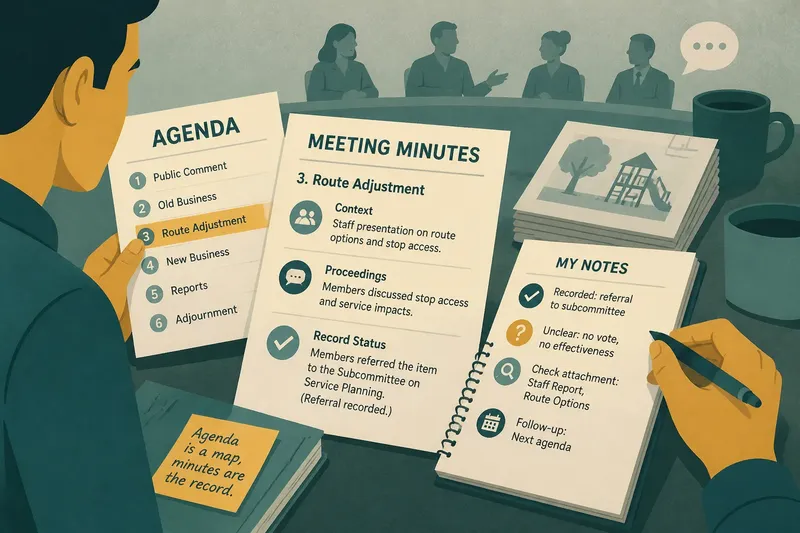
Reading meeting minutes is easier when you follow the agenda and identify what the record says happened under each item. Minutes are usually a concise account, not a transcript, so the agenda, procedural terms, and referenced documents help show where the record is clear and where it stops.
Use the agenda to locate the record
Begin with the meeting’s name, date, and attendance information. These details establish which gathering the minutes cover. A board meeting and a committee meeting may address the same issue but involve different participants or responsibilities.
Scan the agenda titles before reading an item closely. Minutes may group business by topic, committee, or type of proceeding. Note references to agendas, staff reports, attachments, or exhibits; those materials may provide context that the minutes leave out.
Headings such as “public comment,” “old business,” and “new business” help you find material, but they do not establish that an action occurred. An agenda lists planned business, while minutes record what the meeting document says took place. An item can be delayed, changed, combined with another item, or considered in a different order.
Keep the agenda beside the minutes, but treat it as a map rather than proof of what happened.
Trace an item through its recorded events
Read the full entry for one agenda item before moving on. A compact passage may mention a presentation, questions, a procedural action, and a result. Reading only the first sentence can miss a later note that changes the status of the item.
Separate the entry into three parts:
- Context: the issue, report, or proposal before the body.
- Proceedings: what the minutes say happened, such as discussion, referral, amendment, or postponement.
- Record status: any stated vote, action, or unresolved point.
Verbs offer clues, but they need context. “Heard,” “received,” and “discussed” describe activities and may not indicate authorization. “Referred,” “continued,” or “adopted” point to different procedural events; the body’s rules and the sentence around each verb determine what the minutes establish.
Say you are reading invented minutes from a neighborhood transit committee. Under “Route adjustment,” the entry says members heard a staff presentation, discussed stop access, and referred the item to a subcommittee. The recorded result is the referral. The entry does not say that the route adjustment took effect or was rejected.
Read through to the last sentence before deciding what the entry records.
Read procedural language in context
Minutes often use compact terms for events that have specific meanings under an organization’s rules. The same word can be used differently across settings, so consult the relevant procedure materials when a term affects what happened next.
For example, “tabled” can refer to setting an item aside, but its procedural effect depends on the body’s rules and how the minutes use the word. Check whether the entry states a later date, a referral, or another next action. If it does not, mark the next step as unclear rather than supplying one from assumption.
“Approved” also needs an object. Members might approve earlier minutes, accept a report, or authorize a particular action. Identify what the sentence says was approved, and check whether the record includes a motion, vote, or other stated procedure.
When the wording is ambiguous, note the phrase as written and identify what additional record could clarify it.
Questions readers ask about meeting minutes?
Do meeting minutes include everything people said?
Minutes commonly summarize proceedings rather than reproduce every statement, though practices vary among organizations. Treat them as a record of selected events, not a complete transcript.
What does it mean when minutes say an item was tabled?
The meaning and effect depend on the body’s rules and the surrounding entry. Check the procedure materials and look for a stated next action before deciding whether the item was postponed, set aside, or otherwise handled.
Can minutes explain why a decision was made?
They may record reasons raised during discussion, but they may omit much of the deliberation. Distinguish reasons explicitly included in the record from your own explanation of what motivated members.
What if the minutes mention an action but give no result?
Write down what is missing, such as whether a vote occurred or who will follow up. Then check a later set of minutes, an attachment, or a formal action record instead of inferring the result.
Keep confirmed details separate from open questions
A useful note for each item states what the minutes explicitly record, what remains uncertain, and which record might clarify the uncertainty. For example, a direction to prepare a report does not establish that the report was completed; a later record would be needed to confirm that.
Use this check as you make a note:
- Meeting details: If the body or date is missing from your note, add it before comparing this record with others; if it is already clear, move on to the agenda item.
- Item wording: If the title is broad or likely to change, copy a distinctive phrase from the entry; if it is specific, use the title to find related records.
- Recorded event: If the minutes name an action or result, describe only that event; if they describe discussion without a result, mark the outcome as unstated.
- Procedural term: If a word such as “tabled” affects what happened next, check the body’s rules; if the entry still leaves the meaning open, record that uncertainty.
- Attachment reference: If the minutes cite a report or exhibit, note its title or identifier and check the document; if no attachment is cited, do not assume one was adopted.
- Follow-up: If the entry names a later meeting, deadline, or responsible group, note that detail and search for it; if it names none, leave the next step unresolved.
Imagine a fictional parks committee entry that says members “supported” a playground concept and asked staff to return with revised drawings, but records no vote. Your note would say that the minutes record expressed support and a request for revised drawings, while authorization is unstated. If a later agenda lists the drawings, that can clarify the follow-up; it would not by itself turn the earlier wording into a recorded vote.
References to attachments deserve particular care. A report may explain a proposal while the minutes record only that it was presented. Record the document name so you can locate it, but do not treat its inclusion in a meeting packet as proof that members formally adopted it.
Terms such as “consensus,” “direction,” and “support” may describe a view or instruction without specifying a formal action. Preserve the minutes’ wording and avoid converting it into a stronger claim than the record supports.
Check later records without rewriting earlier ones
A later meeting can clarify what happened after an earlier entry. A referral may return with a report, or a postponed topic may appear under a revised title. Search by the issue name and by distinctive phrases, since agenda headings can change.
Keep the dates and meeting names attached to your notes. A later update adds information about the sequence; it does not change what the earlier minutes recorded at the time.
For each item, write the meeting body and date, the agenda title or a distinctive phrase, the event explicitly recorded, any open question, and the later record or attachment that could answer it. This makes it easier to follow the document trail without filling gaps with assumptions.
Reading meeting minutes this way keeps the record’s boundaries visible: the agenda helps locate an item, procedural language describes what the minutes report, and later documents may clarify what followed. The search phrase “reading meeting minutes” is most useful when it leads you to the exact record and leaves unsupported conclusions out of your notes.